Winning AI Search as a Discoverability System
How SEO, AEO, and GEO become one operating model when crawl access, entity clarity, retrieval structure, and citation trust work together.
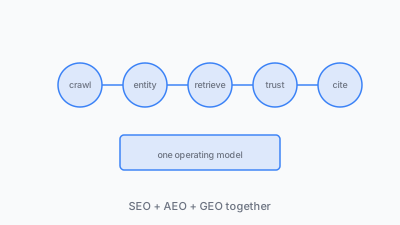
Key takeaways
- AI search is not a new channel layered on top of the site. It is a stricter test of the same discoverability system.
- Ranking, answer extraction, and generated citation all depend on structural clarity before they depend on phrasing.
- Pages that define one topic well tend to travel farther across search and answer surfaces than pages that chase many weak terms.
Teams often talk about "winning AI search" as if it requires a new playbook detached from SEO. In practice, it requires a better integrated one.
Search engines still need to crawl pages. Answer systems still need to understand what the page is about. Retrieval systems still need stable entity and section boundaries before they can reuse content confidently. What changes is that the margin for ambiguity gets smaller.
The practical goal is not to optimize for one surface at a time. The goal is to make each page easy to crawl, easy to classify, easy to retrieve, and easy to cite.
What does winning AI search actually require?
Winning AI search requires one coherent discoverability system rather than separate SEO, AEO, and GEO tricks. This page is for builders and teams shaping durable topic pages, and the operating question is whether each page is easy for crawlers, retrieval systems, and answer interfaces to trust at the same time.
In practice, discoverability compounds when one page does one job clearly instead of trying to rank, answer, and persuade all at once.
Act I: The actual objective
What winning AI search really means
Winning AI search does not mean forcing your page into every assistant response. It means building pages that survive three filters:
- they can be discovered and indexed,
- they can be retrieved for the right question,
- they can be cited or summarized without distorting the original claim.
That is why the same page architecture supports SEO, AEO, and GEO together. See SEO, AEO, GEO: How Discoverability Actually Works for the full pipeline view, then use this page as the execution lens.
Act II: The operating layers
Layer 1: Access and trust
No retrieval system can help a page that is blocked, mis-canonicalized, excluded from the sitemap, or hidden behind poor internal linking.
This is still the mechanical floor:
- indexable HTML
- stable canonical URL
- consistent sitemap coverage
- real
404handling for dead pages - enough internal links for crawlers to reach priority documents
This layer is not glamorous, but it keeps weak technical signals from corrupting everything downstream.
Layer 2: Entity and section clarity
Once a page is reachable, the next question is whether the system can classify it correctly.
That depends on:
- one durable topic per page
- titles and descriptions that match visible content
- consistent entity names across the site
- clear section identity so related pages reinforce each other
This is where an entity glossary and section map matter more than keyword stuffing. A system can retrieve what it can name and separate. Use Entity Glossary for AI Discoverability as the canonical naming layer and treat Sentences and Shelf as supporting surfaces, not disconnected archives.
Layer 3: Answer shape and retrieval shape
AI search rewards pages that can be lifted cleanly into a different interface.
| Layer | Weak pattern | Stronger pattern |
|---|---|---|
| Access | Mixed canonicals, thin crawl paths, soft 404s | Stable URLs, sitemap coverage, real status codes |
| Meaning | One page chasing too many intents | One durable topic with explicit entities and sections |
| Reuse | Long narrative without answer-ready anchors | Definition-first structure, scoped claims, comparison blocks |
That usually means:
- a direct explanation near the top
- strong heading hierarchy
- comparison blocks or concise definitions
- examples with visible boundaries
- internal links that clarify what is adjacent but not identical
Pages that only gesture at a topic may still rank for broad queries, but they are harder to quote, retrieve, and cite. This is why AEO and GEO as a retrieval design problem matters so much: answer surfaces are less forgiving than result pages.
Act III: Practical execution
What good pages share
The pages that travel best across search and AI surfaces usually share five properties:
- they define the topic before expanding it
- they avoid mixing too many intents into one URL
- they reinforce the same entity from multiple sections
- they cite adjacent pages with descriptive anchors
- they stay truthful about scope instead of overclaiming
The Winning AI Search deck is useful here as the compact reference version. The long-form discipline lives in the pages around it.
What this changes in practice
Treat AI search optimization as a site architecture problem, not a phrasing problem. Fix crawl access, define entities cleanly, build answer-shaped pages, and let internal links show the system around the topic.
Related reading:
FAQ
Is AI search optimization different from SEO?
The output surfaces differ, but the upstream work overlaps heavily. Stable entities, clear structure, and trustworthy evidence help ranking, answer extraction, and generated citations together.
What should be optimized first for AI search?
Start with crawl and canonical health, then tighten topic boundaries, answer-ready structure, and internal links. Retrieval quality improves when the site map is already coherent.