Entity Glossary for AI Discoverability
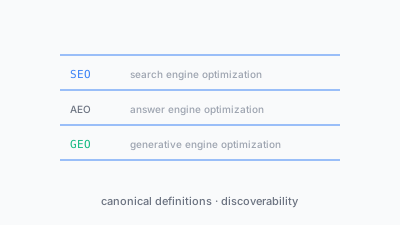
Canonical definitions for recurring SEO, AEO, GEO, and runtime concepts used across this site.
Key takeaways
- Entity consistency is a retrieval advantage, not only an editorial preference.
- Canonical term anchors reduce semantic drift across sections.
- Definitions should be stable, concise, and linked where concepts recur.
- A glossary is most useful when schema, headings, and body language align.
A site can have excellent writing and still underperform in search, answer extraction, and generated citations if core terms are used inconsistently. The issue is not only keyword variation. The deeper issue is entity drift: the same idea being named differently without clear boundary rules.
This glossary exists to keep recurring concepts stable across systems, sentences, self, and shelf pages. It is both a reader aid and a machine-readable anchor surface.
What does an entity glossary actually do?
An entity glossary gives a site one stable vocabulary for recurring ideas, so retrieval systems do not have to guess whether similar phrases mean the same thing. This guide is for builders and operators who want stronger discoverability without losing editorial range, and it works best when the glossary is linked into live pages instead of treated as a dead appendix.
In practice, definition stability is a compounding asset.
Act I: Why entity anchors matter
The entity-layer problem
When multiple pages describe related concepts with unstable naming, systems struggle to link them as one evolving body of knowledge. Humans can often infer intent from context; retrieval engines are less forgiving.
A glossary solves this by defining canonical names and boundaries. Once stable anchors exist, pages can vary in tone and depth without losing conceptual continuity.
What makes a good definition anchor
A strong anchor is:
- short and unambiguous
- scoped (what it includes and excludes)
- reusable across sections
- stable over time
Question-style definition blocks also improve answer extraction quality.
What is an entity anchor?
An entity anchor is a stable, linkable definition of a recurring concept. It gives humans and machines one canonical reference point, so meaning stays consistent even when pages differ in style, depth, or context.
Act II: Canonical definitions
Core discoverability terms
| Glossary job | Without a canonical term | With a canonical term |
|---|---|---|
| Retrieval | Passages compete because naming drifts | Related chunks reinforce the same concept |
| Citation | Claims look inconsistent across pages | Systems find repeatable language and safer anchors |
| Maintenance | Each update risks redefining the concept | Scope stays stable while phrasing can adapt |
Runtime and governance terms
Act III: Operating usage rules
How to apply these definitions
Use this glossary as the canonical layer for recurring terms.
- Link to anchors when introducing a concept in new pages.
- Keep wording in headings and schema aligned with these terms.
- Update definitions only when conceptual boundaries truly change.
- Prefer one canonical term over multiple near-synonyms for the same idea.
For systems-level application, see SEO, AEO, GEO: How Discoverability Actually Works, AEO and GEO as a Retrieval Design Problem, and Knowledge Management as Runtime Memory. For the compact reference layer, see the Winning AI Search deck.
What this changes in practice
A glossary does not replace deep content. It stabilizes it. When canonical definitions stay clear and linkable, your pages become easier to discover, easier to quote, and easier to maintain as a coherent system.
Proof Block
- Canonical term anchors are mapped in article schema via DefinedTerm URLs.
- Cross-section pages now reference stable entity names for retrieval consistency.
FAQ
Why keep an entity glossary when terms seem obvious?
Because retrieval systems and humans both degrade when terminology drifts across pages. Canonical anchors preserve continuity, reduce ambiguity, and improve citation reliability.
How often should these definitions be updated?
Only when conceptual boundaries actually change. Minor wording tweaks are fine, but the canonical term identity should stay stable.