AEO and GEO as a Retrieval Design Problem
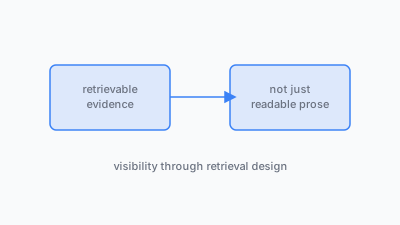
Answer and generative visibility improve when pages are designed as retrievable evidence, not only readable prose.
Key takeaways
- AEO and GEO failures are usually retrieval failures before they are writing failures.
- Engines need clear chunks, stable entities, and scoped claims to reuse content.
- Citation probability rises when evidence is explicit, attributable, and internally consistent.
- Good prose helps humans; retrievable prose helps machines choose your content.
Many teams publish excellent long-form writing and still see weak answer-surface visibility. The missing layer is retrieval design. Machines do not read pages the way humans do; they rank passages, extract units, and compose from evidence candidates.
If those candidates are ambiguous, buried, or inconsistent, your page can be high quality and still lose at answer time.
What makes AEO and GEO a retrieval design problem?
AEO and GEO become retrieval design problems when strong writing still fails to survive passage selection and citation checks. This page is for teams trying to improve answer visibility without flattening their voice, and the practical goal is to make each section easy to retrieve, rank, and reuse with the right boundary intact.
In practice, clarity at boundaries reduces downstream errors more than late-stage tuning.
Act I: The fundamentals
Retrieval before generation
Answer and generative systems typically run a sequence:
- retrieve candidate passages
- rank candidates for relevance and confidence
- compose a response from selected evidence
- optionally attach citations
If your strongest claim never survives step one or two, generation quality cannot rescue it. This is why AEO and GEO performance often depends more on retrieval architecture than on writing style.
What makes a passage retrievable
A retrievable passage usually has four properties:
- bounded scope: one claim, one context, one outcome
- entity clarity: stable names for products, concepts, and methods
- local completeness: enough context in the same chunk to stand alone
- verifiable framing: concrete language instead of vague assertions
Narrative writing often distributes these properties across multiple paragraphs. Humans connect them. Retrieval systems may not. That is why stable terminology matters as much as prose quality; the Entity Glossary for AI Discoverability is the canonical layer that keeps recurring terms retrievable across this site.
Act II: The modern paradigm
Chunking, entity design, and evidence shape
The retrieval unit is rarely the whole page; it is usually a chunk. That means chunk boundaries become product decisions.
Weak chunking patterns:
- oversized chunks containing several unrelated claims
- pronoun-heavy text with missing entity anchors
- key definitions separated from the paragraphs that depend on them
Strong chunking patterns:
- one major claim per paragraph group
- explicit nouns repeated where precision matters
- short definition blocks near section starts
- tables for boundary comparisons and tradeoffs
| Signal | Weak pattern | Strong pattern |
|---|---|---|
| Claim shape | General opinion language | Bounded, testable claim |
| Entity clarity | Term changes across pages | Consistent naming + local context |
| Evidence location | Buried in long narrative | Front-loaded definitions + anchors |
| Cross-page coherence | Isolated documents | Intentional internal link graph |
Why citation is a trust decision
GEO is not only about retrieval probability. It is also about whether a system judges your passage safe to cite.
Citation decisions are more likely when claims are:
- specific in scope ("for SMB teams under 10k pages," not "for everyone")
- explicit about method and boundary
- aligned with adjacent pages on the same topic
- traceable to stable URLs and clear section headings
This is where internal consistency matters. If two pages define the same concept differently, a model may avoid citing either to reduce contradiction risk.
For top-level framing, see SEO, AEO, and GEO in Plain Terms.
Act III: Principles in practice
Retrieval-ready page pattern
A practical page pattern for AEO/GEO:
- Start with a compact definition block and one-sentence thesis.
- Use clear H2 and H3 anchors that mirror common query intent.
- Keep paragraphs short and claim-focused.
- Add one comparison table where ambiguity is likely.
- Link related internal pages with specific anchor text.
- End with a concrete "what this changes in practice" section.
This does not make writing robotic. It makes evidence extraction reliable.
A diagnostic checklist
Run this check on any underperforming page:
- Can a reader quote one exact claim per section?
- Does each claim contain named entities, not only pronouns?
- Would a chunk still make sense out of page context?
- Are internal links reinforcing or fragmenting the concept graph?
- Do two related pages contradict terminology or scope?
When answers are mostly "no," retrieval quality is usually the bottleneck.
For full pipeline design from crawl to citation, see SEO, AEO, GEO: How Discoverability Actually Works. For the memory layer that keeps retrieval inputs stable over time, see Knowledge Management as Runtime Memory. For the condensed execution version, use the Winning AI Search deck.
What this changes in practice
Design every important page as evidence infrastructure: easy to retrieve, easy to rank, and easy to cite without ambiguity.
Proof Block
- Framework document for retrieval design
- Referenced in seo-aeo-geo-how-things-fit-together.mdx
FAQ
Why is AEO and GEO a retrieval problem?
AEO and GEO failures are usually retrieval failures before they are writing failures. Engines need clear chunks, stable entities, and scoped claims to reuse content. If your pages aren't designed for retrieval, even excellent writing won't be selected.
What makes content more likely to be cited by AI systems?
Citation probability rises when evidence is explicit (clear claims with sources), attributable (specific data points or definitions), and internally consistent (no contradictory statements across pages). Abstract prose is harder to cite than concrete claims.
How does retrievable prose differ from readable prose?
Readable prose flows naturally for humans. Retrievable prose is chunked for machines: clear headings, concise answer blocks, stable terminology, and explicit attribution. Good pages do both: they are readable AND structured for extraction.