What a Skill Is in AI Systems
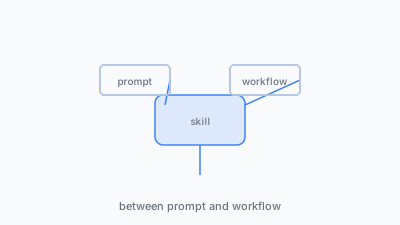
A practical definition of skills as reusable execution units that sit between prompts and workflows in modern AI systems.
Key takeaways
- A prompt gives an instruction; a skill packages a reusable capability.
- Skills are useful because they preserve constraints, inputs, and expected outputs across runs.
- Workflows orchestrate skills, and agent systems execute those workflows in runtime.
- If a repeated task cannot be described, tested, and reused, it is not yet operating like a skill.
This guide helps teams and builders design robust capabilities. The term "skill" is getting popular because teams have started to notice the same architectural problem in many tools. A model can respond well once, but that does not automatically create a reliable capability you can reuse inside a larger system.
That gap matters. If every repeated task has to be re-explained from scratch, the system remains conversational instead of operational. A skill is the first step toward making repeated language work behave more like software.
What is a skill in practical terms?
A skill is a reusable execution unit built around a repeated task. It defines what the task is for, what inputs it expects, what constraints shape it, and what output contract it should satisfy. In AI systems, a skill sits between a raw prompt and a larger workflow.
In practice, a skill is useful when it reduces interpretation debt across repeated runs.
Act I: Where skills fit
From instruction to capability
Many teams begin with direct prompting:
- ask the model to summarize
- ask it to draft a spec
- ask it to propose a refactor
- ask it to write tests
This is fine for exploration. It becomes weak when the same task appears over and over and still depends on informal phrasing each time.
That is the point where a repeated instruction should become a named capability. The useful sequence looks like this:
- Intent: what outcome is needed?
- Prompt: what instruction initiates the task?
- Skill: how is that task packaged for reuse?
- Workflow: how does the skill connect to adjacent tasks?
- Agent system: what runtime executes and governs the workflow?
Why skills appear now
Different platforms use different names:
- skills
- tools
- actions
- tasks
- extensions
The naming changes, but the architectural need is the same. Systems need reusable units of execution that can be invoked repeatedly without rewriting the entire context every time.
This is why skills matter in AI-assisted SDLC. Repeated tasks like "summarize diff risk," "compile release notes," or "generate a constrained implementation plan" should not stay as ad hoc instructions forever. They should become stable operating units.
Act II: The systems role of a skill
The operating sequence
A skill is useful because it narrows ambiguity at the point where repetition begins.
| Layer | Main question | Typical artifact |
|---|---|---|
| Prompt | What am I asking for right now? | Task instruction |
| Skill | How does this repeated task behave each time? | Reusable capability contract |
| Workflow | How do several skills combine to finish a job? | Step sequence with handoffs |
| Agent system | How are workflows executed, governed, and observed? | Runtime with policies, tools, and logs |
This is also why skills fit naturally with Agent Instructions and Handoff as an Operating System. Once a skill is named and bounded, it can be governed more cleanly inside a larger agent workflow.
What belongs inside a skill
A useful skill usually contains:
- one objective
- known input expectations
- clear constraints
- an output contract
- some way to judge success or escalation
It does not need to be a full platform feature. It needs to be reusable enough that another run, another person, or another agent can invoke it with roughly the same intended behavior.
If you want the comparative model, continue to Skills vs Prompts vs Agents. If you want templates to define these more concretely, see AI skill design templates.
The same idea also fits the Dual NLP for AI-assisted SDLC page. In that model, natural language first interprets intent, then NLPg compiles that intent into a more governed execution form. A skill sits exactly at that transition point.
Act III: Using skills well
When a task should become a skill
A task usually deserves skill status when:
- it happens often enough to justify reuse
- it has recurring inputs and expected outputs
- quality depends on a stable constraint set
- the team wants to evaluate or version it over time
That means not every prompt should become a skill. Exploratory work can remain conversational. Repeated work should become more structured.
If you want to see the handoff point in a concrete local-tool workflow, use Ollama launch: integration handoff. It shows what happens when a reusable capability stops being just an idea and starts behaving like a named operating surface.
Failure patterns
Teams usually misuse skills in three ways:
- calling any prompt a skill
- making skills so broad they become full workflows
- ignoring output contracts and then claiming the skill is reusable
These failures are predictable because they come from unclear boundaries.
For the conceptual comparison layer, see Skills vs Prompts vs Agents. For runtime framing, see Tech Stack for NLPg-Driven AI-Assisted SDLC.
What this changes in practice
You stop treating repeated language work as informal conversation and start treating it as a reusable capability that can be named, tested, and orchestrated.
Proof Block
- Skills are introduced here as reusable execution units, not as standalone prompt tricks.
- The page links skills to workflows, agents, and the Dual NLP framework already used across the site.
FAQ
Is a skill just another name for a prompt?
No. A prompt is a single instruction surface, while a skill is a reusable capability with clearer boundaries, expected inputs, and repeatable outputs.
Why do skills matter in AI-assisted SDLC?
They reduce repeated interpretation work by turning common tasks into reusable capability units that can be evaluated, versioned, and orchestrated.