The Logic Void: Where AI Reasoning Breaks Down
Where AI reasoning reaches its boundaries, why those boundaries matter for system design, and how to build reliable systems that acknowledge the limits of logic.
Key takeaways
- AI reasoning has clear boundaries where logic becomes unreliable.
- The logic void is not a flaw; it is a design surface.
- Systems that acknowledge limits are more trustworthy than systems that pretend to be certain.
- Designing for the void means building fallbacks, escalation paths, and uncertainty signals.
This article explains where AI reasoning breaks down, why those boundaries matter for system design, and how to build reliable systems that acknowledge the limits of logic.
What is the logic void in AI reasoning?
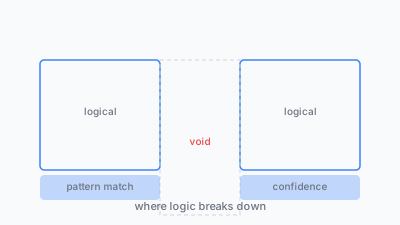
The logic void refers to the boundary where an AI model's statistical pattern-matching fails to resolve ambiguous inputs, conflicting priorities, or out-of-distribution scenarios. Because language models do not possess a true internal model of logical truth or ethical consensus, they cannot reliably navigate these gaps, leading to sudden reasoning collapse or confident hallucinations.
| Scenario Type | Model Behavior in Void | System Fallback Path | Success Criteria |
|---|---|---|---|
| Deterministic | Pattern matches training data | Direct execution | High accuracy (automated check) |
| Ambiguous context | Extrapolates probabilistically | Escalate for clarification | Graceful fallback / prompt user |
| Value conflict | Vulnerable to prompt oscillation | Enforce strict policy rules | Safety gate verification |
It is most useful for teams building AI systems that need to handle edge cases, and for anyone trying to understand why confident AI outputs can still be deeply wrong.
Where logic ends
AI systems are trained on patterns in data. They are good at extrapolating from those patterns, but they struggle in situations that require:
- novel reasoning beyond the training distribution
- contextual judgment that depends on unstated values
- handling ambiguous inputs without failing silently
- recognizing when the question itself is malformed
The logic void is not a bug. It is a boundary condition that every AI system eventually encounters.
Act I: The nature of the void
What the void looks like
The logic void appears in several recognizable forms:
- Ambiguity without disambiguation signal: the input could mean multiple things, and the system picks one without signaling uncertainty.
- Novel situations: the query describes a situation unlike anything in the training data.
- Value conflicts: multiple valid principles conflict, and the system cannot reason about which takes precedence.
- Malformed questions: the question itself contains a category error or false premise.
Each form produces confident outputs that are unreliable without the system knowing it.
Why confidence misleads
Language models produce fluent output regardless of whether the situation is inside or outside their reliable range. Fluency is not a signal of validity. The system cannot tell you where it stops being reliable.
This is why calibration matters. A calibrated system can express uncertainty. An uncalibrated system produces the same confident tone whether it is answering a simple factual question or hallucinating in the void.
Act II: Designing for the void
Uncertainty signaling
The first line of defense is making the system express uncertainty when it is operating in the void. This requires:
- explicit uncertainty thresholds based on input characteristics
- flagging when queries match novel or ambiguous patterns
- expressing confidence intervals rather than binary answers
See Decision-Making Under Uncertainty in AI Runtimes for the operating model.
Fallback patterns
When the system detects the void, it should fall back to:
- rule-based responses for known boundary cases
- retrieval from governed knowledge bases instead of model memory
- explicit acknowledgment that the query is outside reliable range
Escalation paths
For high-stakes decisions in the void, the system should escalate to human judgment. This requires:
- clear escalation triggers based on query characteristics
- seamless handoff that preserves context
- documented escalation outcomes for future learning
Act III: Trust through honesty
The honest system
Systems that acknowledge their limits are more trustworthy than systems that pretend certainty. When a system says "I am uncertain about this," users can adjust their trust accordingly.
When a system produces a confident answer in the void, users may trust it inappropriately. The honest system earns long-term trust by being clear about where it stops being reliable.
See Runtime Over Model: Why Orchestration is the Product for how orchestration discipline supports honest systems.
What this changes in practice
Do not design systems that avoid the void. Design systems that acknowledge the void, signal when they are operating in it, and handle those situations gracefully. That is what separates reliable AI from impressive AI.
Related AI systems topics
Proof Block
- This doc is backed by The Logic Void shared resource.
- Ties to decision-making under uncertainty and runtime over model docs.
FAQ
What is the logic void in AI systems?
The logic void is the boundary where AI reasoning stops being reliable: ambiguous inputs, novel situations, value conflicts, and situations that require contextual judgment beyond pattern matching.
Why does the logic void matter for system design?
Because systems that do not acknowledge where logic ends often fail silently at the boundaries. Understanding the void lets you design appropriate handoffs, fallbacks, and human oversight.
How do you handle decisions in the logic void?
You handle them by building appropriate constraints: rule-based fallbacks, human escalation paths, uncertainty signaling, and graceful degradation instead of confident wrong answers.