Decision-Making Under Uncertainty in AI Runtimes
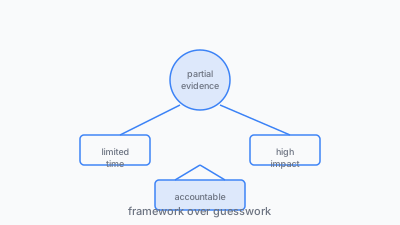
A practical framework for making accountable decisions in AI systems when evidence is partial, time is limited, and outcomes are high-impact.
Key takeaways
- Most AI failures are decision failures under uncertainty, not generation failures.
- Good runtime decisions balance policy, evidence, and reversibility.
- Escalation rules should be explicit before incidents happen.
- Decision quality improves when teams log rationale, not only outcomes.
AI systems rarely fail because the model cannot produce language. They fail when the system makes a weak decision while evidence is incomplete. This guide is built for builders, operators, and engineering teams launching AI runtimes. In production, you are often choosing under time pressure, with ambiguous context, and with real consequences if you are wrong.
That is why decision-making deserves first-class architecture. A runtime should not only ask "what can the model do?" It should ask "what should the system allow now, with this evidence, at this risk level?"
What is decision-making under uncertainty in AI systems?
It is the practice of choosing explicit action modes when information is incomplete, using policy constraints, evidence quality, and reversibility as primary criteria. The objective is not to appear certain but to make accountable choices that can be reviewed, corrected, and improved after execution.
In practice, uncertainty is normal; unmanaged uncertainty is the risk.
Act I: Why runtime decisions fail
The decision gap
Many teams have strong prompt patterns and solid model choices, but still experience unreliable outcomes. The gap is usually between proposal and permission:
- the model proposes an action
- the runtime decides whether to execute
- the system records and learns from the result
If that middle decision is weak, everything around it becomes fragile. You may ship fast, but reliability becomes luck-driven.
The hardest part is that weak decisions often look fine at first. A wrong choice can still produce polished output. The problem appears later as rework, user corrections, silent drift, or policy breaches.
Three types of uncertainty
Decision quality improves when you classify uncertainty instead of treating it as one vague state.
Context uncertainty The system is missing relevant facts or receives conflicting inputs.
Model uncertainty The model provides plausible alternatives with no strong confidence separation.
Outcome uncertainty The action may succeed technically but still cause undesirable downstream effects.
Each type needs a different response. Context uncertainty usually needs retrieval or clarification. Model uncertainty may need a second check or stricter constraints. Outcome uncertainty often needs reversible actions or human review.
Act II: Decision architecture
The PE-R loop: policy, evidence, reversibility
A practical decision loop under uncertainty can be simplified to three checks.
- Policy: Is this action allowed in this context?
- Evidence: Do we have enough support for this action now?
- Reversibility: If wrong, how costly is recovery?
If policy fails, deny. If evidence is weak but impact is low and reversible, allow with trace. If evidence is weak and impact is high, ask or defer.
This loop prevents one common anti-pattern: treating confidence language as evidence. Confidence in phrasing is not the same as confidence in system state.
Decision modes: allow, ask, deny, defer
The runtime should expose clear decision modes instead of burying logic in prompts.
| Mode | Use when | Required artifact |
|---|---|---|
| allow | Policy passes and evidence is sufficient | Execution + verification trace |
| ask | Need human confirmation or missing critical context | Clarification request with rationale |
| deny | Policy violation or unacceptable risk | Denial reason code |
| defer | Insufficient evidence and high potential impact | Escalation handoff record |
This model also helps teams debug decisions without blame. You can evaluate whether the wrong mode was selected, whether evidence rules were weak, or whether policy definitions were outdated.
For related runtime control framing, see From Agent Intent to Governed Execution. For observability implications, see Observability First: How AI Systems Learn After Launch. At the human-interaction level, allow/ask/deny/defer is the same decision surface the I-7 Cognitive Loop names Interpret and Inspect: state assumptions before execution, then verify against evidence before trusting the result.
For proof surfaces beyond theory, use Portfolio for workflow and enablement examples, and Soothsayer MCP kernel: from prompts to controlled orchestration for a local runtime case where escalation and verification matter.
Act III: Operating discipline
How to design escalation thresholds
Escalation rules work best when they are concrete and pre-agreed. A useful pattern:
- Define action classes by potential impact (low, medium, high).
- Define minimum evidence per class.
- Define when human confirmation is mandatory.
- Define rollback path for each allowed action class.
Without these thresholds, teams escalate inconsistently and drift into intuition-led decisions. Consistency matters more than perfection because consistent decisions are learnable decisions.
What to log for better decisions
If you only log outcomes, learning is slow. Log rationale and context with each decision:
- uncertainty type detected
- selected decision mode (
allow|ask|deny|defer) - policy version used
- evidence sources and quality score
- reversibility class
- post-action verification result
This creates a decision memory that can be audited and improved. Over time, teams can identify patterns: recurring false-allow decisions, over-escalation, or policy rules that are too broad.
For a reflection on building this habit, see Decision Logs Beat Memory. For a concise principle view, see A decision rule is a kindness to your future self.
What this changes in practice
Stop asking systems to be "certain" before they act. Ask them to be explicit about uncertainty, choose a decision mode with clear rationale, and leave a trace that can be reviewed. That shift turns decision-making from improvisation into infrastructure.
Proof Block
- Decision-making topic now spans systems, sentences, and self sections.
- Decision mode taxonomy (allow/ask/deny/defer) is documented with explicit artifacts.
- Rationale logging pattern has a paired self-practice note for operational adoption.
FAQ
Can uncertainty be eliminated before decisions?
Usually no. The goal is not elimination but explicit classification and safe response modes tied to policy and evidence.
Why log rationale if outcomes are already tracked?
Outcome-only logs hide why the decision was made. Rationale logs let teams improve policy, evidence thresholds, and escalation rules.