Skill Evaluation and Versioning
How to define expected behavior, detect regressions, version skill changes safely, and decide when rollback is the right move.
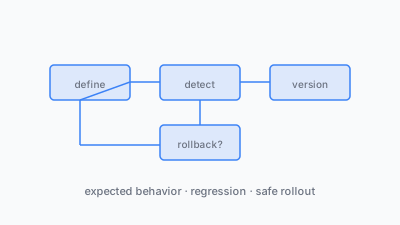
Key takeaways
- Skills need expected behavior definitions before they need version numbers.
- Regression detection depends on stable test cases and clear output contracts.
- Versioning should track behavior changes, not only text edits.
- Rollback decisions should be based on impact and reversibility, not intuition alone.
Once a skill becomes reusable, it creates a new operational problem: how do you change it safely? A prompt can be edited casually because its blast radius is often local. A skill is different. It may sit inside workflows, feed downstream systems, or operate under tool permissions that make changes consequential.
That is why skills need evaluation and versioning. Without them, the same mechanism that makes a skill reusable also makes its failures repeatable at scale.
What does it mean to evaluate a skill?
Evaluating a skill means checking whether it still performs its intended task under the expected inputs, constraints, and escalation rules. The evaluation should confirm not only output quality, but also whether the skill behaved within its contract.
In practice, a skill version is only meaningful when the expected behavior is explicit.
Act I: Define what should stay stable
Expected behavior before version numbers
Do not start with the version label. Start with the behavior that must remain understandable.
A skill should define:
- what task it is supposed to accomplish
- what output shape it promises
- what constraints it should respect
- what circumstances require escalation
- what side effects are allowed or forbidden
If these stay implicit, a version number does not help much. You can say the skill moved from v1.2 to v1.3, but that does not explain whether the skill became safer, more permissive, more accurate, or more fragile.
This is why Designing Reusable AI Skills comes first. Design establishes the contract. Evaluation and versioning protect that contract over time.
What should be tested
The most useful test set usually includes:
- one normal case
- one borderline case
- one failure or missing-input case
- one escalation-required case
| Test type | Question it answers | Signal to watch |
|---|---|---|
| Nominal | Does the skill behave as intended on standard input? | Output quality and contract fit |
| Boundary | Does it stay stable near ambiguity or thin context? | Consistency and overreach |
| Failure | Does it fail clearly when inputs are insufficient? | Graceful refusal or fallback |
| Escalation | Does it stop when risk or uncertainty is too high? | Correct handoff behavior |
These do not need to become an overly large suite. They need to stay stable enough that behavior changes can be noticed early.
Act II: Detect and manage change
Regression detection
Regression detection is less about perfection than about noticing the wrong kind of drift.
Useful regression signals include:
- output no longer matches the contract
- escalation happens less often when risk is unchanged
- the skill requires more context than before
- downstream workflows need extra correction
- a safer old behavior is replaced by a more confident but less bounded one
This is the same logic used in Evaluation as a Runtime Discipline. The skill should not only be judged on what it says, but on whether it still behaves correctly as part of a runtime system.
Versioning logic
Versioning is useful when it reflects behavior, not only edits.
A practical rule:
- patch-level change: wording or structure improved without changing behavior expectations
- minor change: behavior expanded or tightened without changing the core purpose
- major change: output contract, tool authority, or escalation logic changed in a way that affects downstream use
The exact labels matter less than consistency. People using the skill should be able to tell whether the change is cosmetic, operational, or breaking.
If you want a compact starting structure, use the AI skill design templates page and treat the review template as the minimum change log.
Change communication
Versioning fails when no one knows what changed.
Good change communication includes:
- short summary of what changed
- expected behavior difference
- affected workflows or downstream dependencies
- test cases used for verification
- any rollback caveats
This is where skill design starts to look more like software operations than prompt curation. That is a good sign.
Act III: Decide whether to keep or roll back
Rollback conditions
Rollback should not feel dramatic. It should be a normal response to the wrong kind of change.
Rollback is usually appropriate when:
- the skill violates its output contract
- tool or side-effect boundaries become less safe
- key test cases fail
- downstream workflows degrade noticeably
- escalation behavior weakens under uncertainty
Rollback is especially important when the skill is reused in several places. The cost of one bad change compounds quickly when reuse is the whole point.
Failure patterns to watch
Several patterns often indicate that a skill needs rollback or redesign:
- success rate appears stable but manual correction rises
- a version improves one case by weakening boundary behavior elsewhere
- the skill becomes more verbose instead of more reliable
- the team cannot explain why the new version should be trusted more
- "small" edits repeatedly change how downstream systems must interpret the output
These are operational warnings, not editorial preferences.
For the conceptual layer, see What a Skill Is in AI Systems. For the comparison layer, see Skills vs Prompts vs Agents.
What this changes in practice
You stop treating skill updates as casual prompt edits and start treating them as controlled behavior changes that need tests, versions, and rollback logic.
Proof Block
- This page gives the skills cluster a direct operational layer for testing, regression control, and rollback logic.
- Versioning guidance is linked back to the template asset and the reusable-skill design page.
FAQ
What should be versioned in a skill?
Anything that changes expected behavior: instructions, constraints, tool permissions, output contracts, and escalation rules.
When should a skill be rolled back?
When the new version increases risk, breaks downstream expectations, or fails agreed test cases in ways that cannot be safely contained.