Natural Language Is the New API
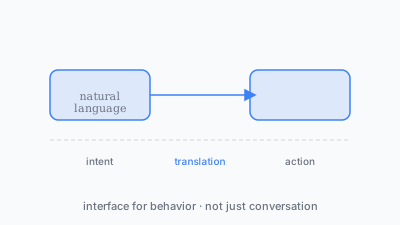
Why natural language is an interface for machine behavior, not just a conversation.
Key takeaways
- Natural language is now an interface for system behavior.
- A prompt is a contract: it defines intent, constraints, and success criteria.
- Vague language leads to probabilistic failure; precise language leads to reliable execution.
- We are moving from "command-based" interfaces to "intent-based" interfaces, where the machine determines the implementation details.
- Documentation must treat prompts as code, capturing version history, expected outputs, and failure modes.
For decades, the Application Programming Interface (API) served as a stable, predictable contract for machine-to-machine communication. It demanded structure, precision, and technical knowledge. That era is giving way to a new abstraction layer: natural language. Powered by Large Language Models (LLMs), the primary interface to complex systems is no longer a set of rigid commands but a human request.
However, treating this as casual conversation is a mistake. In a business context, natural language is an executable specification. It is code written in English. We are moving from a world where humans had to learn the machine's language (JSON, SQL) to one where the machine attempts to interpret ours. The "API" is no longer the endpoint you call, but the meaning you specify.
Why is natural language becoming an API layer?
Natural language is becoming an API layer because modern systems can now interpret intent, not only rigid commands. This page is for teams designing AI-enabled workflows, and the important shift is that language must be treated as a versioned operating contract instead of a casual interface.
Act I: The fundamentals
Core Concepts: From Endpoints to Embeddings
The old model of APIs was built on discrete, well-defined endpoints. To create a user, you would POST /users. To get data, you would GET /data?id=123. The new model is based on semantic similarity.
- **REST API**
- The old model. A structured, endpoint-based contract where the client must know the exact address and format the server expects. Highly reliable but rigid.
- **Intent**
- The user's underlying goal, expressed in their own words. For example, "I need to add my colleague to the project" instead of knowing to call a specific function.
- **Embedding**
- A mathematical representation of text (a word, sentence, or document) as a vector of numbers. Words with similar meanings have similar vectors.
- **Vector Search**
- The core mechanism for finding meaning. When a user provides a query, the system converts it to an embedding and searches a database for the most similar vectors, which correspond to known actions or data.
Act II: The modern paradigm
The Socio-Technical Merge: A Practical Example
Let's revisit the marketing plan example through the lens of a socio-technical system, as defined in Systems 001: Foundations.
The Intent: A marketing manager says, "Generate a weekly marketing plan for our new product launch. Include three social media posts, a customer newsletter draft, and a reminder to analyze last week's results."
This request initiates a flow across three layers:
- Human Layer: The manager supplies the strategic and ethical context. They know the product, the target audience, and the overall business goal.
- Machine Layer: The LLM receives the intent. It doesn't look for a single endpoint called
generate_marketing_plan. Instead, it uses its training to break the request down into a sequence of probable actions:find_product_details(name="new_product")create_social_post(platform="Twitter", content="...")(3 times)draft_email(template="newsletter", content="...")create_calendar_reminder(date="Friday", text="Analyze campaign results")
- Interconnectivity: This is the feedback loop. If the term "new product" is ambiguous, the system might respond, "Which new product are you referring to? 'Project Phoenix' or 'Project Apollo'?" This turns the interaction from a simple command into a dialogue, making the system more resilient.
Act III: Principles in practice
Failure Modes and Resilience
A Natural Language API is powerful but introduces new, probabilistic failure modes that don't exist in traditional, deterministic APIs. In deterministic systems, errors are usually syntax violations or logic bugs. In probabilistic systems, errors are often semantic misunderstandings. The system doesn't crash; it confidently does the wrong thing. This requires a shift from "bug fixing" to "behavior shaping".
| Failure Mode | Early Signal | Design Response |
|---|---|---|
| Ambiguity | System asks for frequent clarification or produces irrelevant results. | Improve context priming with better system prompts or use few-shot examples. For high-stakes actions, implement a human-in-the-loop confirmation step. |
| Hallucination | System generates plausible but factually incorrect details (e.g., inventing features for a product). | Use Retrieval-Augmented Generation (RAG) to ground the model with a specific knowledge base. Include citations in the output to show the source of information. |
| Prompt Injection | User input tricks the model into ignoring its original instructions, leading to data leaks or unauthorized actions. | Implement strict input sanitization, output validation, and run the model with the lowest possible privileges on backend tools.{" "} Never trust user input. |
Prompts as Contracts
In this new paradigm, the prompt is not a suggestion; it is a contract. It defines the agreement between the human operator and the probabilistic engine.
- Intent: What exactly are we trying to achieve? (e.g., "Summarize this email" vs "Extract action items from this email").
- Constraints: What is forbidden? (e.g., "Do not use external knowledge," "Do not be polite, be concise").
- Success Criteria: How do we know if it worked? (e.g., "Output must be valid JSON").
What this changes in practice
Treating language as an API shifts who is responsible and how work gets done.
- Define intent explicitly. State goals, constraints, and success criteria in plain language.
- Version the contract. Track prompt changes like code changes; small edits change behavior.
- Ground the model. Use retrieval or curated context instead of relying on memory.
- Design for misunderstanding. Add confirmation steps for high-impact actions.
- Measure behavior, not vibes. Evaluate outputs against the contract, not just fluency.
Related resources
- The Semantic Bridge Framework deck
- Code the Omnichannel System deck
- Intent Architecture as a Language Contract
Conclusion: The System Is the Message
The shift to natural language interfaces is not about replacing developers. It's about closing the gap between intent and execution for everyone. It makes the power of a complex system accessible to the people who have the business context.
As with any powerful abstraction, this comes with new responsibilities. We must design these systems for resilience, govern their actions, and document their intent. The system is the message, and in this new era, the message is one of dialogue, context, and shared meaning between humans and machines.
References
- Attention Is All You Need (2017). Open reference link
- Retrieval-Augmented Generation for Knowledge-Intensive NLP Tasks (2020). Open reference link
- OpenAI API Documentation. Open reference link
Proof Block
- Core conceptual reference for natural language interfaces
FAQ
Why is natural language now considered an API?
Natural language has become an interface for triggering machine behavior, not just a medium for conversation. When prompts define intent, constraints, and success criteria, they function as API contracts that software can invoke and depend on.
What makes a good natural language interface contract?
A good NL interface contract specifies: the action to perform, the input format, the output format, the constraints to respect, and the error behavior. This mirrors traditional API design but uses natural language as the invocation mechanism.
How do natural language interfaces differ from traditional APIs?
Traditional APIs accept structured, typed inputs and return structured outputs. NL interfaces accept free-form language and return free-form language. The flexibility of NL input makes contracts harder to enforce and requires explicit specification of intent.