Intent Architecture as a Language Contract
How intent becomes usable system behavior only after language is converted into explicit contracts, policies, and execution boundaries.
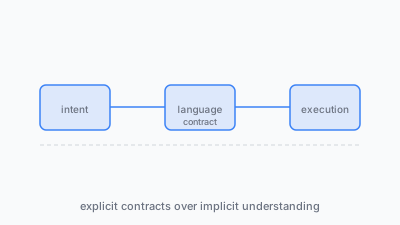
Key takeaways
- Intent is useful only when the system can translate it into enforceable structure.
- Natural language feels expressive because it is ambiguous; architecture exists to contain that ambiguity.
- The real product surface is the contract between user intent and system action.
People often say a system should "understand the user's intent." That sounds right and hides the hard part. Intent by itself is not executable.
A system needs a way to turn language into bounded artifacts: schemas, policy checks, tool parameters, expected outputs, and escalation rules. Without that conversion, the system is not handling intent. It is guessing near it.
Intent architecture is the design layer that converts open language into explicit contracts the runtime can evaluate, enforce, and trace.
In practice, the contract is what protects meaning from collapsing during execution.
Act I: The problem
Why intent is not enough
Users speak in goals. Systems act through constraints.
What is intent architecture in practical terms?
For builders and operators, intent architecture is the translation layer between open-ended language and enforceable system behavior. It decides how a request is interpreted, what structure that interpretation must produce, and which actions become valid only after the runtime applies policy and verification.
That gap is where many failures begin. A user may ask for an outcome in broad human language, while the runtime needs specific fields, valid operations, and allowed side effects.
If that translation remains implicit, the system cannot reliably tell whether it understood the request or merely produced language that sounded aligned.
Act II: The contract model
The three contract layers
A practical intent architecture usually relies on three contract layers:
- Meaning contract: what the request is trying to achieve.
- Structure contract: what fields, schema, or format the system expects.
- Execution contract: what actions are allowed, blocked, or escalated.
The first layer preserves user meaning. The second makes it machine-usable. The third protects the real world from ambiguous action.
For a broader framing, see Natural Language Is the New API. For a concrete enforcement mechanism, continue to Structured output and why it matters.
| Contract layer | Main question | Failure when weak |
|---|---|---|
| Meaning | What is the user actually trying to achieve? | The system optimizes the wrong goal |
| Structure | What shape must the request take to be usable? | Downstream services receive vague or unstable payloads |
| Execution | What actions are allowed, blocked, or escalated? | Language leaks into unsafe or ungoverned side effects |
Where semantic drift begins
Semantic drift usually starts when one layer is missing:
- a broad request is accepted without enough structure
- a structured payload is generated without policy checks
- a valid tool call is executed without verifying whether it matched the original meaning
This is why intent architecture is not only a prompt problem. It is a systems problem spanning interfaces, runtime policy, and verification.
It is also a maintenance problem. Once a system ships, terms begin to drift across prompts, UI labels, docs, and downstream integrations. If the contract is not explicit, a small wording change can silently alter behavior. Strong intent architecture keeps the operational terms visible enough that teams know which words are descriptive and which ones are binding.
Act III: System consequences
How language interfaces stay safe
Language interfaces become safer when they make contracts visible:
- request categories are named
- output shape is explicit
- tool boundaries are narrow
- escalation rules are not hidden in prose
That keeps the system interpretable even when the user request is naturally open-ended.
These practices do not make language robotic. They make it dependable. A user can still ask for something in natural language, but the system should become more precise as it gets closer to action. That progression from expressive input to constrained execution is the whole point of the contract model.
It also preserves collaboration quality. When teams can see the contract, they can review it, version it, and improve it together. When the contract stays implicit inside prompt prose, every change becomes harder to evaluate and every incident becomes harder to explain.
The The Intent Architecture Blueprint deck is the compact visual version of this same design logic.
What this changes in practice
Treat intent as the beginning of architecture, not the end of understanding. Convert it into explicit contracts, then let the runtime decide what can safely happen next.
Related reading:
Proof Block
- Core reference for structured output principles
- Defines language as executable contract
FAQ
What is intent architecture?
Intent architecture is the design of how user intent gets translated into enforceable system behavior through explicit contracts, policies, and execution boundaries. Intent alone is not executable; it must be converted into structured specifications that systems can act on.
Why is natural language ambiguous for systems?
Natural language feels expressive because it allows multiple interpretations. The same phrase can mean different things in different contexts. Architecture exists to contain this ambiguity by defining explicit contracts that map intent to specific actions.
What is a language contract in AI systems?
A language contract is an explicit specification of what an input means, what conditions trigger it, what the expected output is, and what constraints apply. Unlike natural language prompts that can be interpreted multiple ways, contracts are structured enough to be enforceable by runtime systems.