From Ad-Hoc Prompts to Repeatable Agent Workflows
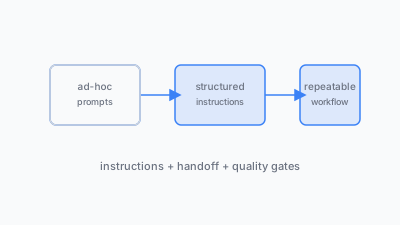
A practical case study showing how structured instructions, handoff memory, and quality gates improved consistency and coverage in this repository.
Key takeaways
- The highest leverage change was process architecture, not a single prompt trick.
- Measurable checks made quality conversations faster and less subjective.
- Cross-section topic mapping improved coherence and discoverability.
- Evidence-based reporting made gap closure explicit.
This case study is designed for practitioners, builders, and content operations teams who want to build stable agent systems. It captures what changed in this repository when we moved from reactive prompt edits to an operating model built on instruction contracts, handoff continuity, and quality gates. The focus is practical: what we changed, what improved, and what lessons hold for other teams. You can inspect the implementation templates that were developed from this workflow in the AI skill design templates.
What changed from before to after?
Before: workflow quality depended on session context and manual review. After: workflow quality is guided by explicit contracts and validated with repeatable checks. The result is higher consistency across docs, clearer gap tracking, and safer publishing cadence.
In practice, the shift from conversational quality to operational quality unlocked compounding gains.
Act I: Baseline and intervention
Baseline state
Initial pain points were familiar:
- inconsistent structure across long-form docs
- uneven use of callouts, highlights, and internal links
- no single, measurable view of topic coverage or strategic gaps
- repeated context reset between sessions
The main issue was not missing effort. It was missing system behavior.
Intervention sequence
The rollout followed a deliberate sequence.
- Contract layer: strengthen instruction rules for section-specific standards.
- Memory layer: enforce handoff protocol with concise, dated updates.
- Measurement layer: add consistency, coverage, and gap reporting scripts.
- Execution layer: run topic clusters in batches (observability, knowledge-management, decision-making).
- Schema/evidence layer: add glossary anchors, FAQ capability, proof blocks, and update metadata.
This sequence kept risk low while improving quality continuously.
Act II: Evidence and outcomes
Observable outcomes
The process produced measurable signals:
- systems consistency checks passing with expanded doc count
- topic coverage report progressing from thin/missing areas to no thin/missing seeded action candidates
- main strategic gaps marked addressed by deterministic reporting
- full build passing after each batch
These are operational signals, not vanity metrics. They indicate reduced drift and improved reproducibility.
Mini benchmark snapshot (from this repository)
A useful pattern was to track a few stable checks after each batch instead of inventing new metrics each time.
lint:systemsmoved from failing docs during transition phases to passing consistently after structural normalization and follow-up updates.report:topicsmoved from thin or missing strategic seed areas to no thin/missing seeded action candidates.report:gapsgives one page of status for core concerns (entity, schema, evidence, AEO, distribution framework), reducing subjective "are we done?" debates.
This benchmark is intentionally small. The goal is operational trust, not dashboard complexity.
Before/after summary
| Dimension | Before | After |
|---|---|---|
| Consistency | Style and structure varied by session momentum | Section standards enforced with lints and templates |
| Continuity | Context often re-established manually | Handoff protocol keeps decisions and next steps persistent |
| Gap visibility | Qualitative and fragmented | Scripted topic and gap reports with explicit status |
| Publishing confidence | Heavily reviewer-dependent | Checks provide a repeatable pre-deploy baseline |
For architecture detail, see Agent Instructions and Handoff as an Operating System, Entity Glossary for AI Discoverability, and Knowledge Management as Runtime Memory.
Act III: Reuse model
What transfers to other teams
The transferable pattern is simple:
- define explicit operating rules
- preserve continuity state
- automate high-signal checks
- execute in scoped batches
- validate every batch before deploy
This works across content teams, product docs teams, and AI operations teams.
What not to copy blindly
Do not copy every rule as-is. Copy the pattern.
- If checks are too strict for your context, teams bypass them.
- If reporting is noisy, it stops being used.
- If handoff files become long narratives, they lose operational value.
A good system is strict where failure is costly and flexible where exploration is needed.
What this changes in practice
You stop relying on individual session quality and start relying on process quality. That shift makes AI-assisted work more stable, teachable, and scalable.
Proof Block
- Systems consistency checks are passing at 31 systems docs.
- Strategic topic seed coverage now reports no thin/missing action candidates.
- Main gap report marks entity, schema, evidence, and AEO gaps as addressed, with distribution framework in place.
FAQ
What changed first in the workflow?
Instruction and handoff discipline came first, then automation scripts, then content cluster rollout with measurable checks.
What was the biggest practical win?
Moving from subjective quality discussions to script-backed status checks reduced drift and improved publishing confidence.