On Mental Frameworks
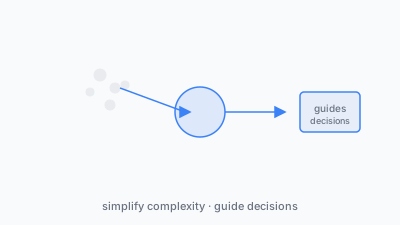
A model for how frameworks simplify complexity and guide decisions in technical and human systems.
Key takeaways
- A framework is a system of assumptions, signals, and decisions.
- Good frameworks compress complexity without hiding risk.
- Frameworks drift when incentives change or feedback is weak.
- In teams, frameworks become socio-technical: shared language plus action.
What is a mental framework?
A mental framework is a structured set of assumptions, signals, and rules that compresses real-world complexity into consistent decision-making patterns. For practitioners and leaders, shared mental frameworks function as socio-technical infrastructure: they provide a shared language for communication and coordinate action across teams.
In practice, clarity at boundaries reduces downstream errors more than late-stage tuning.
Act I: The fundamentals
The frame model
| Element | Role | Failure if missing |
|---|---|---|
| Signals | What you notice in the environment. | Blind spots and delayed reaction. |
| Assumptions | What you treat as true. | Fragile decisions and overconfidence. |
| Decision rule | How the frame converts input into choice. | Inconsistent outcomes. |
| Feedback | How reality updates the frame. | Drift and repeating mistakes. |
Key characteristics
- Reusable: a framework works across multiple scenarios.
- Compresses: it makes a complex problem smaller without hiding risk.
- Legible: you can explain it to someone else.
Act II: The modern paradigm
Frameworks as socio-technical systems
In teams, a framework becomes shared infrastructure. It is a blend of language, process, and governance. When a team says “we prioritize impact,” that phrase is a system: it shapes what gets funded and what gets ignored.
Drift and misalignment
Frameworks drift when incentives change, data shifts, or feedback is ignored. The result is familiar: teams keep following the framework, but outcomes get worse.
Act III: Principles in practice
Build a usable framework
| Step | Action | Output |
|---|---|---|
| Scope | Define what the framework is for. | A clear boundary. |
| Signals | Choose the inputs that matter. | Consistent signals. |
| Rules | Write the decision rule explicitly. | Repeatable choices. |
| Feedback | Define how outcomes update the frame. | Learning loop. |
Framework audit checklist
- What signals are we ignoring?
- Which assumption no longer holds?
- Where do decisions feel inconsistent?
- What feedback are we missing?
For related systems context, see Systems 001: Foundations and From Prompt to Production.
What this changes in practice
- Make frameworks explicit. Write the rules so they can be tested, not just remembered.
- Audit on cadence. Revisit assumptions when incentives or data shift.
- Design for drift. Build feedback loops so the frame updates before it fails.
To see how shared mental frameworks guide technical operations, refer to our AI strategy 2026 presentation deck.
Conclusion
Frameworks are systems for thinking. When they are explicit, they scale judgment. When they are hidden, they drift.
References
- Daniel Kahneman, Thinking, Fast and Slow (2011). Open reference link
- Dave Snowden, Cynefin Framework. Open reference link
Proof Block
- Core thinking framework document
- Referenced in decision-making-under-uncertainty-in-ai-runtimes.mdx
FAQ
What is a mental framework?
A mental framework is a system of assumptions, signals, and decisions that compresses complexity into actionable guidance. Good frameworks reduce cognitive load without hiding risk, helping you navigate decisions faster without sacrificing quality.
How do frameworks drift?
Frameworks drift when the incentives that shaped them change, or when feedback loops that validate them weaken. A framework that worked for one context may persist into another where it no longer fits. Regular review against actual outcomes keeps frameworks accurate.
Why do teams need shared frameworks?
In teams, frameworks become socio-technical artifacts: they provide shared language for communication and common action for decision-making. Without shared frameworks, teams make inconsistent decisions and waste time renegotiating basics instead of solving problems.