Managing State and Memory Handoffs in Multi-Agent Workflows
How to design robust handoff protocols and shared memory blackboards to preserve state continuity across multi-agent boundaries.
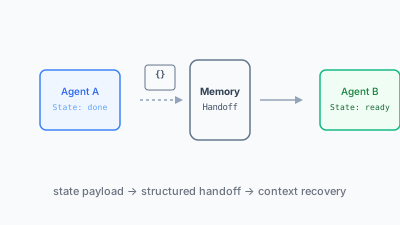
Orchestration quality is determined by the clarity of state transitions at the agent boundary.
Key takeaways
- Handoff protocols must transfer structured state data, not just text.
- Stateless agents lose context between execution turns.
- Shared memory blackboards coordinate complex multi-agent flows.
- Schema-based handoff interfaces prevent context drift between tasks.
This guide is built for builders, teams, and software architects designing complex multi-agent workflows. It details the state design patterns required to establish continuity in cooperative AI systems.
What makes state handoffs reliable in multi-agent workflows?
State handoffs are reliable in multi-agent workflows when they are defined by a strict, machine-parseable contract rather than raw natural language descriptions. A reliable handoff transfers three distinct components: the execution history (what has already been completed), the current state variables (the validated data extracted), and the next-step intent payload (what the receiving agent is expected to accomplish), ensuring the downstream agent starts with complete context.
Act I: The handoff problem
Why Conversational Handoffs Fail
Early multi-agent designs rely on raw text conversations to pass data between agents. For example, a Research Agent writes a long markdown report, and a Writer Agent reads that report to compose a draft. While this conversational approach is simple to implement, it introduces severe noise. As the conversation length grows, critical metadata—such as strict guidelines, file scopes, and numeric limits—is diluted in the prose.
The receiving agent often ignores instructions hidden in the middle of the transcript, resulting in execution drift. The down-stream agent begins to hallucinate previous outcomes because it lacks a structured database of truth.
The Cost of Context Re-generation
When an agent lacks explicit state memory, it must re-process the entire execution history on every turn. This naive design wastefully inflates context window usage. If Agent A runs 10 steps, Agent B must read all 10 steps. This increases token costs and latency, while making it more difficult for Agent B to extract the current actionable goals.
Act II: State patterns
Comparing State Topologies
To resolve conversational drift, multi-agent systems use explicit state management patterns:
- Stateless Handoff: Agents exchange raw chat histories. High flexibility but poor reliability and high token waste.
- Payload Handoff: Agents exchange a structured JSON object containing task variables. The receiving agent only reads the payload, ignoring intermediate chat history.
- Shared Blackboard: A central database stores the system's state variables. Agents read and write to this blackboard, keeping individual agent contexts isolated and compact.
Structured payloads isolate context to keep agent loops predictable.
| State Topology | Context Overhead | Implementation Complexity | Execution Continuity |
|---|---|---|---|
| Stateless Handoff | High (Full history) | Low (Simple chat) | Poor (Prone to drift) |
| Payload Handoff | Low (State variables only) | Medium (Requires JSON parse) | High (Clear boundary) |
| Shared Blackboard | Lowest (Decoupled memory) | High (Requires state manager) | Very High (Auditable timeline) |
The Shared Blackboard Pattern
The Shared Blackboard pattern decouples memory from agent loops. In this design, a central state manager hosts a structured memory schema. When Agent A completes a task, it writes the result to a specific key on the blackboard (e.g., extracted_data: { ... }). When Agent B starts, the runtime queries only the required keys from the blackboard and injects them as prompt variables. This isolates execution errors, limits token overhead, and creates a clear, queryable audit trail.
Act III: Operational reliability
Validation at Transition Points
To ensure reliability, state transitions must be validated:
- Handoff Contracts: Define the input/output schemas for each agent transition.
- Static Assertions: Verify that the output of Agent A satisfies the schema of Agent B before launching Agent B.
- Loop Prevention: Track execution history to detect and break infinite loops where Agent A and Agent B pass the same task back and forth without progress.
For practical templates and guidelines on designing reusable skills and state variables for agent handoffs, check out the AI skill design templates.
What this changes in practice
Stop using raw text transcripts as the sole coordination channel between agents. Define explicit JSON schemas for agent inputs and outputs, and use a structured state manager to control task progression.
Practical takeaways
- Modeled using the execution parameters in our AI skill design templates.
FAQ
What is a state handoff in multi-agent systems?
A state handoff is the explicit transfer of task variables, historical outputs, and ongoing goals from one specialized agent to another.
Why do stateless handoffs fail?
Stateless handoffs force the receiving agent to guess the upstream execution path, leading to redundant work, loss of context, and loop collapse.