What LLM-Ops Actually Means
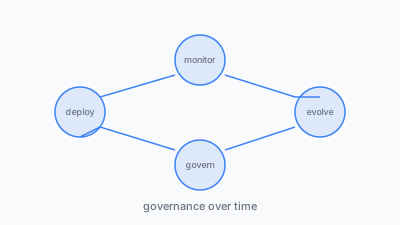
LLM-Ops is governance over time. Understanding the lifecycle of probabilistic systems.
Key takeaways
- LLM-Ops is governance over time. It is the discipline of managing probabilistic risk in production.
- Evaluation replaces deterministic unit testing as the primary confidence mechanism.
- The lifecycle is circular: "prompt → eval → tune → observe → repeat".
- Semantic drift is the new downtime: the system works, but the meaning has changed.
- Monitoring is not just logging; it is detecting when the system's understanding of the world diverges from reality.
In traditional software, operations (Ops) is about keeping the lights on. It focuses on uptime, latency, and error rates. If the server is up and the code doesn't crash, the job is done.
In the era of Large Language Models (LLMs), "Ops" changes fundamental meaning. The server can be up, the latency low, and the code bug-free, yet the system can still fail completely by producing toxic, incorrect, or irrelevant output. LLM-Ops is not just about infrastructure; it is about operationalizing judgment.
What does LLM-Ops actually mean?
LLM-Ops means operating probabilistic systems as living products rather than one-time model launches. This article is for product teams, operators, and builders who need reliable behavior over time, and the real work is evaluation, drift response, and governed change instead of uptime alone.
Act I: The fundamentals
The Operational Shift
The move from deterministic code to probabilistic models requires a shift in mindset. We are no longer managing "functions" that return the same output for the same input. We are managing "agents" that reason, approximate, and sometimes hallucinate.
| Feature | DevOps (Traditional) | LLM-Ops (2026) |
|---|---|---|
| Core Artifact | Compiled Code / Binary | Model Weights + Prompts + Context |
| Testing | Deterministic (Pass/Fail) | Probabilistic (Score/Threshold) |
| Failure Mode | Crash / Exception | Hallucination / Toxicity / Drift |
| Fix | Patch Code | Refine Prompt / Update Context / Fine-tune |
Act II: The modern paradigm
Evaluation Is the New Unit Test
In 2026, you cannot deploy an AI system without an Evaluation Suite. An eval suite is a dataset of inputs and "ideal" outputs (or criteria) used to grade the model's performance.
Unlike a unit test, an eval doesn't say "True" or "False." It says "85% accurate" or "92% relevant."
- Deterministic Evals: Check for JSON validity, forbidden words, or regex matches. Fast and cheap.
- Model-Graded Evals: Use a stronger model (e.g., GPT-5) to grade the output of a smaller, faster model. "Did the assistant answer the user's question politely?"
- Human Evals: The gold standard. Real humans review a sample of outputs to calibrate the automated metrics.
Here is a tiny deterministic eval you can run locally:
gold = {"ticket_1": "refund", "ticket_2": "password"}
pred = {"ticket_1": "refund", "ticket_2": "billing"}

accuracy = sum(pred[k] == gold[k] for k in gold) / len(gold)
print(f"accuracy={accuracy:.2f}")
Benchmarks vs. Runtime Evaluations
While live systems rely on runtime evaluations to monitor operational telemetry, establishing baseline confidence requires static benchmark datasets. These benchmarks check how different models or libraries perform on highly specific tasks.
For example, in document processing and extraction workloads, developers must benchmark OCR tools, layout parsers, and text extractors (such as PaddleOCR, Docling, LlamaParse, and Surya) to determine baseline accuracy, speed, and cost trade-offs before integrating them. As detailed in the comprehensive NewTuple document parsing benchmark, selecting the right model combination based on static datasets is the first step in the LLMOps lifecycle. Once a baseline is selected, continuous runtime evaluation takes over to guard against live behavioral drift.
Act III: Principles in practice
Drift: Semantic vs Data
In traditional ML, we worry about data drift (the input distribution changes). In LLM-Ops, we worry about semantic drift.
Semantic drift happens when the model's understanding of the world diverges from the user's intent. This can happen because:
- The underlying model was updated by the provider (e.g., OpenAI updates GPT-4).
- The context (RAG data) became stale.
- User expectations evolved (e.g., "summarize" now implies "bullet points" to your users).
Monitoring for drift requires tracking feedback signals (thumbs up/down, rewrites) rather than just CPU usage.
Governance as a Loop
Governance is often seen as a bottleneck—a compliance team saying "no." In a mature LLM-Ops practice, governance is a feedback loop.
Policies (e.g., "Do not give financial advice") are encoded into System Prompts and Guardrail Models. When a violation is detected, it doesn't just block the request; it logs an incident for the governance team to review. This turns "compliance" into "dataset improvement."
Conclusion
LLM-Ops is the bridge between a cool demo and a reliable business process. It acknowledges that AI is probabilistic, and therefore requires a system of checks, balances, and continuous measurement to be trusted. It turns the "magic" of AI into the "engineering" of reliability.
For related systems context, see Systems 001: Foundations and From Prompt to Production. For a compact implementation companion, use the Engineering Agentic Systems deck.
What this changes in practice
Treat LLM-Ops as lifecycle ownership: define evals early, monitor drift continuously, and make governance a routine loop, not an audit event.
Proof Block
- Defines the circular LLM-Ops lifecycle
- Referenced in observability-first-ai-systems.mdx
- Links to NewTuple OCR benchmarking blog under the evaluations section.
FAQ
What is LLM-Ops?
LLM-Ops is governance over time for probabilistic systems. It replaces traditional DevOps concerns with evaluation, drift monitoring, and semantic observation. The lifecycle is circular: prompt, evaluate, tune, observe, repeat.
What replaces unit testing in AI systems?
Evaluation replaces deterministic unit testing. Since AI outputs are probabilistic, you need test cases that compare outputs against expected behaviors, patterns, or ground truth rather than exact matches. Evals are typically slower and less deterministic than unit tests.
What is semantic drift?
Semantic drift occurs when the system's outputs remain consistent in form but diverge in meaning from intended behavior. Unlike downtime (obviously broken), semantic drift is subtle: the system works, but its understanding has shifted away from current requirements.