Evaluating Non-Deterministic Outputs with Rubric-Based Pipelines
How to design assertion loops and structured evaluation rubrics to validate probabilistic LLM output quality.
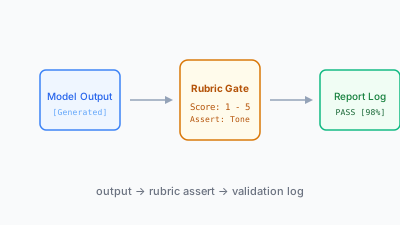
Non-deterministic software requires non-deterministic testing frameworks structured by deterministic validation gates.
Key takeaways
- Exact matching is too fragile for evaluating natural language outputs.
- Rubrics turn qualitative human judgment into structured scoring criteria.
- Assertion pipelines check for structural constraints (like tags, formats, or links).
- Regular evaluation runs provide the trend analysis needed to spot drift early.
This guide is built for builders, quality assurance teams, and operators responsible for verifying generative AI outputs. It outlines how to deploy rubric-based evaluation frameworks in production CI/CD pipelines.
Why are rubric-based evaluation pipelines necessary?
Rubric-based evaluation pipelines are necessary because traditional software testing assumptions (such as expecting an exact, predictable text output) break down when applied to LLMs. Since models can express the same correct fact in infinite ways, evaluation must focus on semantic correctness, compliance with constraints, and tone alignment. A structured rubric divides these qualitative characteristics into clear scoring bands, enabling either human raters or evaluator models to score outputs consistently.
Act I: The limits of old testing
Why Traditional Assertions Fail
In deterministic software, testing is straightforward: you pass input A to function F and assert that the result equals output B. If a single character is misplaced, the test fails. When testing LLM-based systems, this approach is useless. If you ask an agent to summarize an email, the output will vary on every run due to model temperature and training weights.
Asserting that the summary matches a pre-written text block will cause endless false negatives. Conversely, failing to assert anything allows hallucinations and format errors to slip into production unnoticed.
The Noise of Statistical Metrics
Early NLP evaluation relied on metrics like BLEU or ROUGE, which measure n-gram overlap between the generated text and a reference summary. While useful for machine translation, these metrics are blind to meaning. An agent can generate a summary that is factually opposite to the reference text while still receiving a high BLEU score due to vocabulary overlap.
To achieve reliable quality gates, we must transition from lexical matching to semantic validation.
Act II: Designing rubrics
Structuring Quality Dimensions
A production evaluation pipeline uses structured rubrics to analyze outputs across four distinct dimensions:
- Faithfulness: Does the output contain claims not supported by the input context?
- Relevance: Does the response address the user's specific request without adding fluff?
- Compliance: Does the response obey strict formatting and safety rules (like returning valid JSON)?
- Style & Tone: Does the vocabulary match the brand guidelines (such as avoiding hype words)?
Each dimension is graded on a scale of 1 to 5, with each score mapped to explicit criteria.
Rubrics convert subjective opinions into repeatable, auditable metrics.
| Evaluation Method | Automation Speed | Cost per Run | Semantic Accuracy |
|---|---|---|---|
| Exact String Match | Fast (Milliseconds) | Near Zero | Very Low (Fragile) |
| BLEU / ROUGE | Fast (Milliseconds) | Near Zero | Low (Blind to semantic swaps) |
| Rubric-Based (LLM-as-a-Judge) | Medium (Seconds) | Low (API cost) | High (Captures intent and facts) |
Evaluator Architectures
To run rubric evaluations at scale, teams use "LLM-as-a-Judge" setups. A separate, highly capable evaluator model is provided with the input context, the generated output, and the evaluation rubric. The evaluator is instructed to output a score and a detailed rationale justifying the grade. This rationale is critical: it allows developers to debug the evaluator's choices and refine the rubric guidelines over time.
Act III: Production verification
CI/CD Integration and Regression
Running evaluations after launch is good; running them before deployment is better. A robust development workflow integrates a rubric-based evaluation suite directly into the code review pipeline:
- Golden Dataset: Maintain a library of 100+ representative query-context-output pairs.
- Pre-Merge Assertions: Run code changes against the golden set using the evaluator model.
- Regression Flags: If average faithfulness scores drop by more than 0.2, block the merge.
For tools and templates on how to set up grounding and retrieval evaluation tests, refer to the retrieval and grounding evaluation kit.
What this changes in practice
Stop hoping your prompts will stay stable. Build a rubric-based evaluation pipeline, maintain a golden test dataset, and establish code gates to catch behavioral regressions before they reach users.
Practical takeaways
- Built using the validation rules defined in our retrieval and grounding evaluation kit.
FAQ
Why avoid generic string matching for evaluation?
Because LLMs can produce semantically correct outputs using entirely different words, rendering exact string matching (like regex or BLEU) high-noise.
What is a rubric-based evaluation pipeline?
It is an automated or semi-automated verification pipeline that scores model outputs against explicit multi-dimensional quality guidelines rather than simple binary match rules.