Enterprise AI at Scale: From Blueprint to Operating Reality
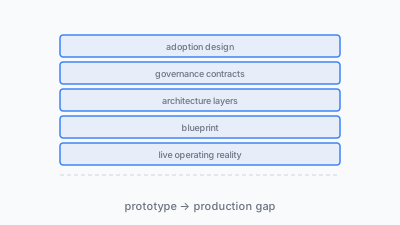
How enterprise AI differs from prototype: the governance contracts, architecture layers, and adoption design that turn blueprints into live systems.
Key takeaways
- Enterprise AI requires governance contracts before architecture decisions.
- Integration layers connect AI to governed source-of-truth systems.
- Adoption design determines whether the system gets used, not just deployed.
- The blueprint must survive policy, audit, and organizational change.
This article explains how enterprise AI systems differ from prototypes and what it takes to move from a promising blueprint to a live operating reality. It covers governance contracts, architecture layers, integration patterns, and adoption design.
What is enterprise AI at scale?
Enterprise AI at scale refers to the production deployment of artificial intelligence systems across an organization, governed by explicit compliance contracts, architectural boundaries, and repeatable integration loops. Unlike isolated developer prototypes, enterprise scale requires deterministic policy gates, auditable execution logs, and seamless connections to legacy systems of record.
It is most useful for teams building or evaluating enterprise AI programs, and for leaders who need to understand what separates a scalable AI initiative from a permanent pilot.
Why enterprise AI is a different problem
A prototype proves that a model can produce useful output. Enterprise AI asks a harder question: can a system produce useful behavior repeatedly, within policy, across teams, and under audit?
The difference is not model quality. The difference is everything around the model: governance, integration, observability, and adoption design. A strong model in a weak system still fails at scale.
Act I: The enterprise AI gap
What prototypes skip
Prototypes work in controlled conditions: clean inputs, one user, no policy boundaries, low consequence for failure. Enterprise systems operate in messy conditions: disconnected data, multiple stakeholders, regulatory requirements, and high consequence for mistakes.
The gap between prototype and production is not model capability. It is system design.
The three scale tests
Enterprise AI only becomes real when it passes three tests:
- Governance: clarity on what the system may do, when, and for whom.
- Integration: connection to governed source-of-truth systems and audit trails.
- Adoption: real users trust the system enough to change their behavior.
If any of these fail, the project stays in pilot mode regardless of model performance.
Act II: Building the blueprint
Governance contracts first
Before any architecture decision, define the governance contract:
- what the system may do autonomously
- what requires human approval
- which policies apply in edge cases
- who owns the change log and audit trail
This contract becomes the specification that architecture enforces. See From Agent Intent to Governed Execution for the operating model.
Architecture layers
Enterprise AI architecture has three functional layers:
- Policy layer: defines boundaries and approval requirements.
- Runtime layer: orchestrates execution within policy constraints.
- Observability layer: monitors behavior and surfaces failures.
Each layer must be independently auditable. See Observability First: How AI Systems Learn After Launch for the operating model.
Integration patterns
Integration connects AI systems to governed data sources. The key patterns are:
- source-of-truth anchoring: AI outputs must be traceable to governed sources.
- audit trails: every significant action must be logged and reviewable.
- fallback handling: the system must degrade gracefully when data is unavailable.
Act III: Making it real
Adoption design
Adoption is not training. It is product design plus organizational trust.
Users adopt AI when:
- the system can explain its reasoning.
- failures are recoverable.
- the workflow reduces cognitive burden.
- trust is earned through consistent behavior.
See Why Most AI Projects Fail After the Demo Stage for the adoption failure patterns.
What this changes in practice
Do not ask whether the blueprint is ambitious enough. Ask whether the governance contracts are clear, the architecture layers are auditable, and the adoption design is honest. That is what separates enterprise AI that scales from AI that stays in pilot.
Related AI systems topics
Proof Block
- This doc is backed by The Enterprise AI Blueprint shared resource.
- Ties to existing post-demo failure, observability, and governed execution docs.
FAQ
What makes enterprise AI different from a prototype?
Enterprise AI requires governance contracts, integration layers, and adoption design that prototypes can skip. At scale, the system must work within policy boundaries, across teams, and under audit requirements.
What comes first in an enterprise AI blueprint?
Governance first. Define what the system may do, what requires human approval, and who owns the outcomes. Then build the architecture to enforce those boundaries.
How do you design for AI adoption in an organization?
Start with high-clarity, high-value workflows. Make the system explain its reasoning. Reduce cognitive burden. Build trust before you scale.