Drift, Decay, and Silent Failure
How systems degrade quietly before they break loudly.
Key takeaways
- Drift is behavior changing over time, not a single defect.
- Silent failure looks like "mostly right" output with shifting meaning.
- Monitoring must track intent alignment, not just uptime and latency.
- Guardrails make drift visible: thresholds, alerts, and review cadence.
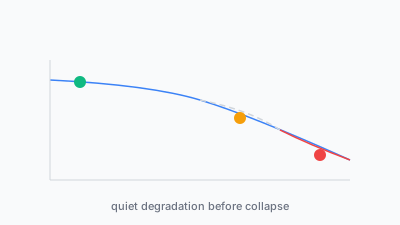
Unlike traditional software which fails loudly and predictably, AI systems can degrade in silence. Their performance can worsen over time due to subtle shifts in the data they process, a phenomenon known as drift. This silent failure is one of the greatest operational risks in production AI.
What causes drift in production systems?
Drift occurs when the data distribution, user behavior, or model response patterns shift over time, leading to gradual behavior change. Because the system's outputs remain structurally valid, these shifts do not trigger typical software exception logs, resulting in silent performance decay rather than a loud application crash.
In practice, clarity at boundaries reduces downstream errors more than late-stage tuning.
Act I: The fundamentals
Two forms of degradation
There are two primary ways an AI system's performance degrades:
- Concept Drift: The statistical properties of the input data change. The real world evolves, but the model's training is static. For example, a model trained to analyze customer sentiment might start to fail as new slang or product names emerge that it has never seen before. The model's "map" of the world is no longer accurate.
- Model Decay: The model's performance on its original task deteriorates over time. This can happen even if the input data doesn't change. It is often a side effect of incremental updates, fine-tuning, or changes in other parts of the software ecosystem.
These issues are insidious because the system doesn't crash. It continues to produce outputs, but they become progressively less accurate or relevant.
Act II: The modern paradigm
Monitoring signals
The solution to silent failure is active monitoring. It is not enough to monitor traditional metrics like latency or uptime. You must monitor the quality and statistical properties of the model's inputs and outputs. This practice is often called "ML Monitoring" or "AIOps."
Modern production AI systems include several layers of monitoring:
- Data drift detection: Statistical tests that compare the distribution of live input data to the training data. An alert is triggered if the distributions diverge significantly.
- Output quality monitoring: A random sample of the model's outputs is regularly captured and sent for human evaluation. This provides a direct measure of whether the model is still meeting its quality objectives.
- Outlier detection: Identifying and flagging inputs that are significantly different from anything the model has seen before. These are often the first sign of drift.
Act III: Principles in practice
Operational guardrails
Assume your model will degrade. A "deploy and forget" mindset is a recipe for failure. Building a successful AI system requires a commitment to continuous monitoring and maintenance.
- Log everything. Keep a record of the inputs, outputs, and any human feedback for every prediction the model makes. This data is invaluable for diagnosing problems and retraining the model.
- Establish a baseline. Before deploying a model, measure its performance on a held-out test set. This baseline is what you will compare against to detect decay.
- Automate your monitoring. Set up automated alerts for data drift and sudden drops in performance. Do not rely on your users to tell you when your model is failing.
- Have a retraining strategy. Plan for how you will update your model with new data. Will you retrain from scratch every quarter? Or will you continuously fine-tune on a stream of new data? The right strategy depends on the application, but you must have one.
For related systems context, see Systems 001: Foundations and From Prompt to Production. For practical tools to evaluate intent alignment and prevent decay, see the retrieval and grounding evaluation kit in our shared resources library.
What this changes in practice
You must budget for continuous monitoring and maintenance as a core part of the operational cost of any production AI system.
Proof Block
- Documents the unique failure modes of probabilistic systems
- Referenced in llm-ops-without-the-buzzwords.mdx
FAQ
What is drift in AI systems?
Drift is gradual behavior change over time, not a single defect. It occurs when the data distribution, user intent, or model behavior shifts subtly. Unlike bugs that cause immediate failure, drift causes slow degradation that may go unnoticed.
What is silent failure in AI?
Silent failure is when outputs remain mostly correct in form but diverge in meaning or accuracy. The system appears to work ("it's generating responses") but the outputs no longer meet requirements. This is harder to detect than loud failures.
How do you detect drift?
Drift detection requires monitoring intent alignment, not just technical metrics. Track evaluation scores over time, compare outputs against known-good baselines, monitor user feedback signals, and set thresholds that trigger review when behavior shifts beyond acceptable bounds.