Context Window Management and Retrieval Pruning Strategies
How to optimize LLM performance and reduce runtime token costs using token-counting, semantic re-ranking, and context pruning.
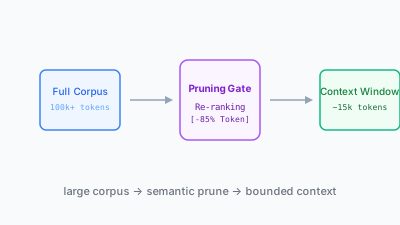
Longer context windows are not a license for lazy retrieval; they are a resource constraints optimization surface.
Key takeaways
- Models perform best with concise, high-density prompts.
- The 'lost in the middle' effect degrades recall as context size grows.
- Semantic pruning removes noise to reduce cost and runtime latency.
- Token budgets must be monitored and enforced programmatically at the API boundary.
This guide is built for developers, operators, and architects managing high-throughput RAG systems. It covers the math and design patterns behind context window pruning and semantic compression.
What is context window pruning in retrieval systems?
Context window pruning is the programmatic extraction and compaction of prompt context to fit within a strict token budget. Rather than passing all retrieved database chunks directly to the model, pruning pipelines use semantic similarity, token counting, and cross-encoder re-ranking to discard low-value information, ensuring that only the most relevant context is fed into the LLM's active working memory.
Act I: The cost of large context
The Lost in the Middle Phenomenon
Modern Large Language Models advertise context capacities ranging from 32,000 to over 1 million tokens. This leads many teams to adopt a naive architecture: search for documents, retrieve the top 50 matches, and dump them wholesale into the system prompt. However, empirical studies show that a model's ability to locate and reason about information within its context is not uniform.
When relevant facts are placed in the middle of a very long prompt, model retrieval accuracy drops significantly compared to when those same facts are located at the very beginning or end of the document. This is known as the Lost in the Middle effect.
Operational Overhead
Beyond recall degradation, massive prompts introduce severe cost and speed penalties:
- Financial Costs: API providers charge per token. Injecting 100k tokens of context for a simple query increases execution costs by orders of magnitude.
- Latency (TTFT): Time-to-first-token scales linearly with prompt size. Large context windows slow down user interfaces and degrade developer experience.
- Attention Waste: Probabilistic models can easily get distracted by irrelevant details, leading to weak reasoning paths.
Act II: Pruning strategies
Semantic Filtering and Re-ranking
An effective context management system uses a two-stage retrieval pipeline:
- Broad Search: A bi-encoder retrieves the top 100 candidate passages using vector similarity.
- Re-ranking & Pruning: A cross-encoder model evaluates the query against each retrieved chunk to produce a precise relevance score. Chunks scoring below a specific threshold (e.g., 0.70) are immediately pruned.
Pruning should reduce raw context volume by 70-90% before prompt assembly.
| Pruning Strategy | Implementation Cost | Context Utilization | Recall Reliability |
|---|---|---|---|
| Full Injection | Low (No filtering) | Poor (Bloated, noisy) | Low (Lost in the middle) |
| Naive Sliding Window | Medium (Truncates text) | Fair (Cuts off early) | Medium (Loss of historical context) |
| Semantic Pruning | High (Requires re-ranker) | Optimal (High density) | High (Retains only relevant facts) |
Naive Sliding Windows vs. Pruning
A naive sliding window truncates historical logs or long documents once they exceed the token limit. This approach is highly destructive because it treats all parts of a document as equally important. In contrast, semantic pruning evaluates each section independently, dropping unhelpful paragraphs while retaining key configuration headers and summary lines, even if they appear early in the file.
Act III: Implementation rules
Enforcing Token Budgets
To prevent out-of-memory errors and runaways, the runtime must enforce strict token budgets at the system boundary:
- Max Context Budget: Establish a hard limit (e.g., 16,000 tokens) for the entire payload.
- Dynamic Allocation: Dedicate 10% of the budget to system instructions, 20% to history, 50% to retrieved context, and reserve 20% for the expected response generation.
- Local Count Verification: Use local tokenizers (like
tiktoken) to measure length before making remote API requests.
For empirical data on how context window capacity changes model quality and when recall begins to bend, check out the Context window stress test local experiment.
What this changes in practice
Treat context as a scarce resource. Implement semantic pruning, measure token usage locally before execution, and monitor TTFT latency metrics to keep retrieval loops performant.
Practical takeaways
- Tested on local models using the context window stress test dataset.
FAQ
What is context window pruning?
Context window pruning is the process of removing redundant, irrelevant, or low-similarity text segments from a model's prompt payload to minimize cost and latency.
Why does context size degrade model recall?
LLMs suffer from the 'lost in the middle' effect, where model recall drops dramatically for facts placed in the middle of long context windows.